
Deconstructing and integrating complex legacy ecosystems for Up Home
- My role
- Product and design lead
- The working team
- Up's COO and relevant SMEs from Bendigo Bank, technical lead and ~6 other engineers, product design, brand and marketing teams
- Project duration
- About 2 years
In late 2020, digital bank Up set a strategic goal to introduce an in-app home loan application and servicing experience. However, banking infrastructure is deeply bound by complex regulatory compliance and fragmented legacy backend systems owned by parent institutions. No centralized documentation existed for the end-to-end flow.
Operating as the product and design lead, I reverse-engineered and mapped the entire multi-party operational topology. I then designed the technical data handoffs, system integrations, underlying mathematical logic matrices, as well as the UX/UI needed to deliver a frictionless, compliant experience.
Discovery: Mapping system topology & regulatory gates
Building a modern lending product within a traditional banking framework is not a standard UI mapping exercise. The core financial systems for Up lived in the backend of Bendigo Bank, meaning our modern application layer had to fit their existing enterprise business processes.
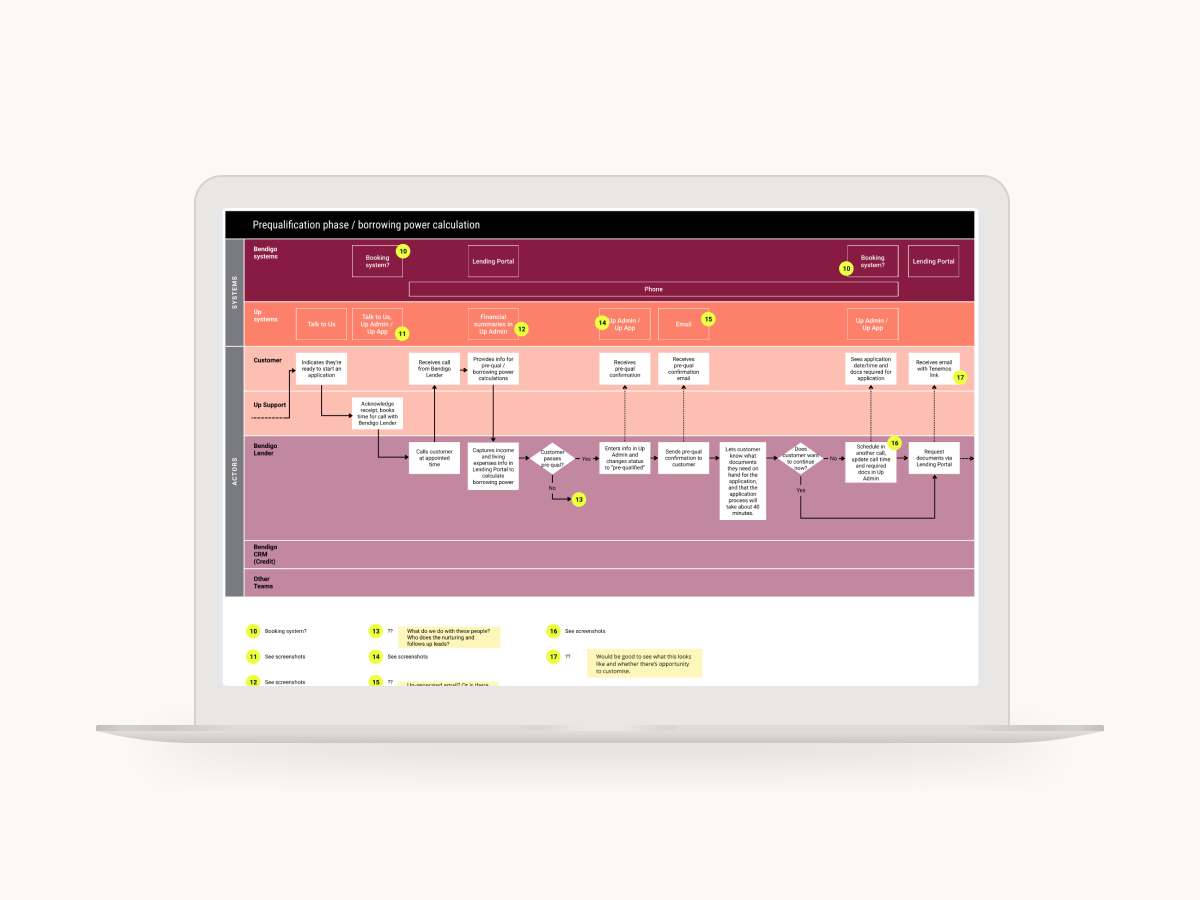
Because no single stakeholder understood the entire lifecycle end-to-end, I spent months conducting cross-functional system discovery. I audited and mapped the data pipelines flowing through an intricate web of internal and external touchpoints, including:
- Third-party data capture engines: the online application architecture managed by Tiimely.
- Manual operational checkpoints: internal lending assessment, financial assistance, and customer support squads.
- Legacy output vendors: external printing and data distribution systems responsible for legally binding contracts and physical statements.
By translating this fragmented ecosystem into a unified system topology map, I identified exactly where data primitives could seamlessly cross boundaries between modern mobile interfaces and legacy banking cores.
Product vision: Strategic pragmatism & system abstraction
Our long-term architectural vision was to fully automate the credit decisioning and servicing stack natively. However, engineering reality dictated that we could not replace the entire enterprise legacy system for day one.
My design strategy shifted to abstracting the system boundaries. I isolated the core touchpoints within the business process where we could intercept the data. I then designed asynchronous data synchronisation patterns and manual-to-technical handovers that maintained our brand’s signature user experience while respecting backend legacy constraints.
For MVP, we needed a solution that balanced our vision and brand values with pragmatism.
Logic design: Modeling deterministic financial matrices
In this project, my high-fidelity output wasn’t just visual mockups; it also included the actual mathematical logic rules of the application.
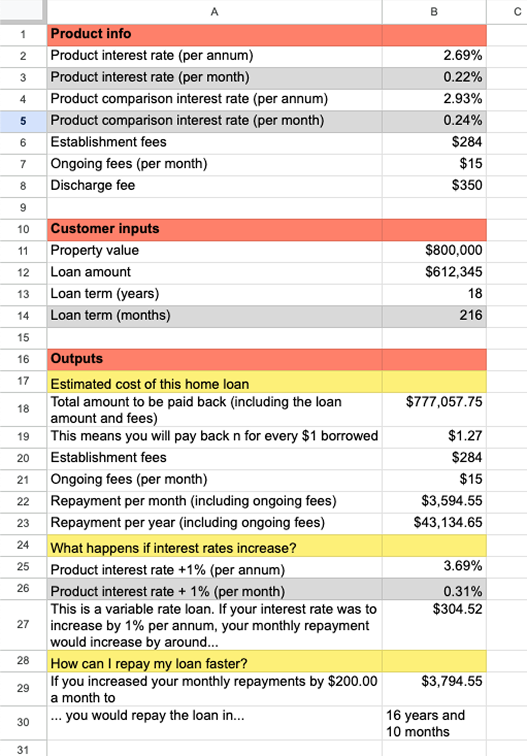
To bridge the gap between compliance regulations and engineering implementation, I modeled the financial logic layer myself. I built comprehensive functional rule spreadsheets mapping out complex multi-variable calculation matrices, including:
- Dynamic stamp duty variations across state jurisdictions.
- Amortization and repayment formulas.
- Regulatory Key Fact Sheet generation constraints.
By delivering these exact logic matrices and algorithmic references directly to the engineering team, we eliminated interpretation errors and ensured business-critical calculations were compiled into code correctly.
UX/UI design: Universal workflows
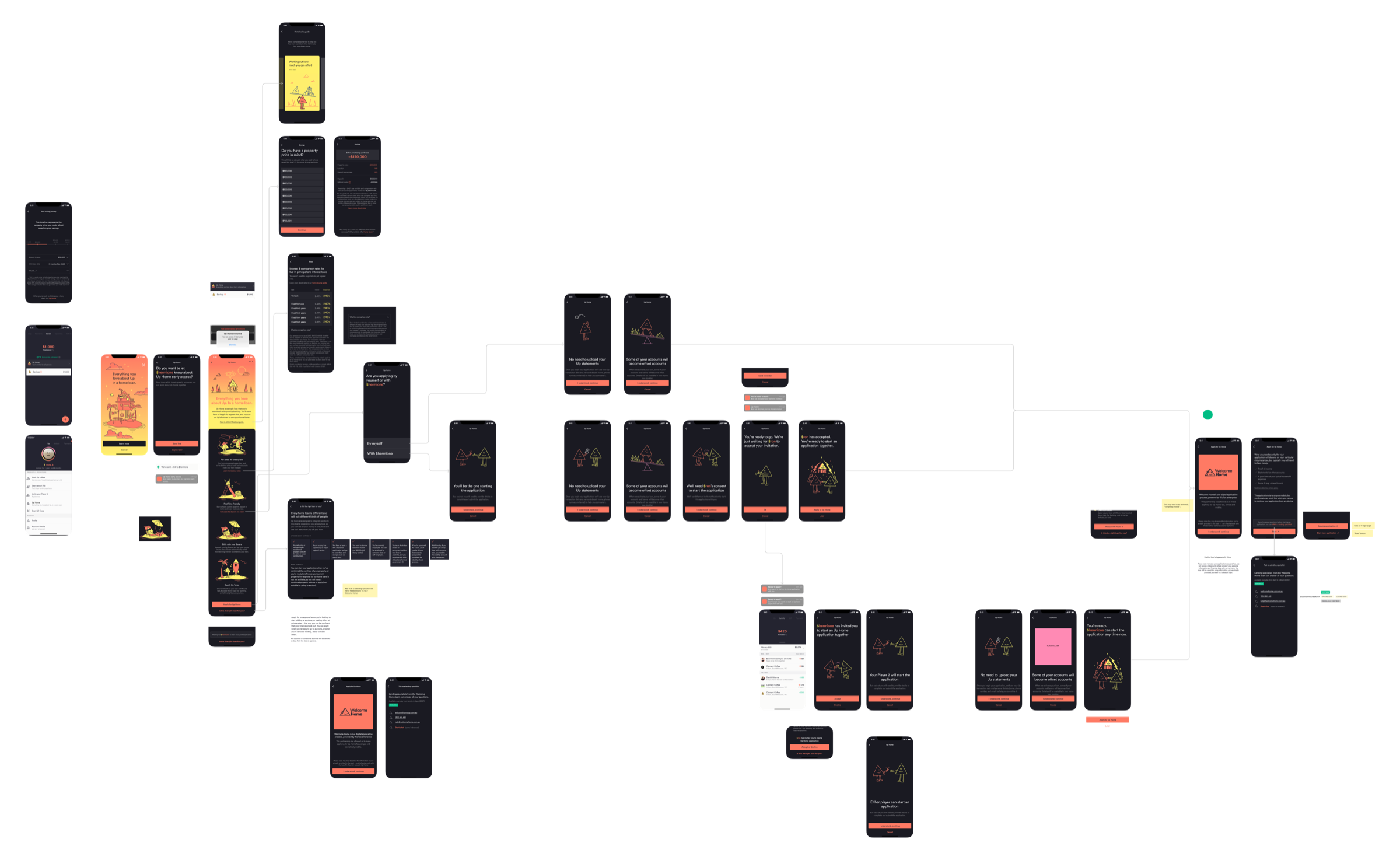
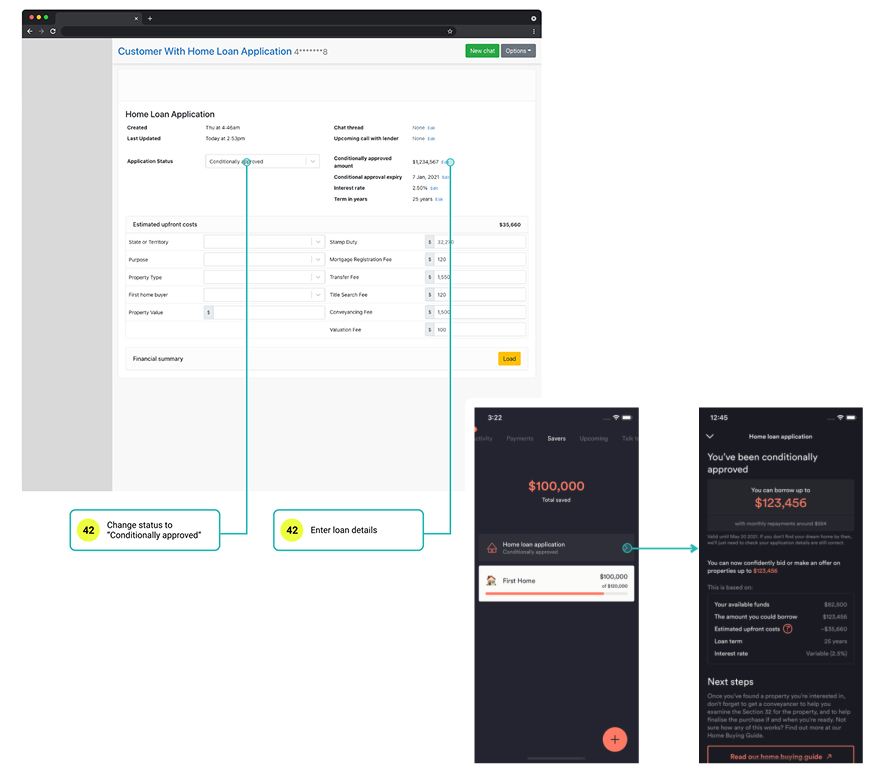
The user experience of a lending platform is a multi-sided network problem. For every simplified customer interface inside the Up mobile app, I designed the corresponding internal administration tooling required to support the data behind the scenes.
While the customer-facing UI had the usual Up flair, thanks to help from other members of the brand and design team, the visual design for internal tools was treated as a clean, low-friction layout designed to manage cognitive load for the back-office lending agents. I mapped data inputs directly to the specialised users’ mental models, ensuring high operational throughput during the manual evaluation phases.
Delivery, release & technical validation

I partnered closely with the COO, tech lead, and six engineers to slice this ecosystem deployment into a managed, phased roll-out. To mitigate systemic risk, I designed an in-app expression of interest data-filtering schema to dynamically segment and qualify user groups for a multi-stage beta release.
The platform successfully scaled from a friends-and-family testing pool to the entire customer base, meeting all financial settlement targets and proving that it’s possible to bring a simple, modern experience to the user even when working with complex, highly regulated legacy systems through rigorous logical design.